Skip to content
Metanoia

METANOIA

Catholic Confession

Turn Back to Grace

Your faithful companion for preparing and receiving the Sacrament of Reconciliation. Examine your conscience. Open your heart. Receive His mercy.

"Come now, let us settle the matter," says the Lord.
"Though your sins are like scarlet, they shall be as white as snow."

— Isaiah 1:18

The Father Waits
for You

The Sacrament of Reconciliation is one of the greatest gifts Christ gave His Church — the assurance of forgiveness, the healing of the soul, and restoration to grace.

Yet many of us approach it with anxiety:

  • What should I confess?
  • What if I forget something during confession?
  • I don't remember the prayers...
  • It's been so long since my last confession...

Metanoia walks beside you

Helping you prepare your heart so you can focus on what matters most: encountering the merciful love of the Father.

"In him we have redemption through his blood, the forgiveness of sins, in accordance with the riches of God's grace."
— Ephesians 1:7

How to Make a
Good Confession

A step-by-step guide to the Sacrament of Reconciliation

1

Before Confession

Examine your conscience, feel genuine sorrow for sin, and resolve to amend your life.

2

Entering the Confessional

Kneel behind the screen or sit face-to-face. Make the Sign of the Cross together with the priest.

3

Confessing Your Sins

State how long since your last confession, then confess simply and honestly — the kind of sin and how many times.

4

Counsel and Penance

Listen to the priest's spiritual guidance and receive your penance — prayers, charity, or sacrifice.

5

Act of Contrition

Pray an Act of Contrition expressing your sorrow and intention to amend your life.

6

Receiving Absolution

The priest speaks the words of absolution. Your sins are truly forgiven — you are reconciled with God.

7

After Confession

Complete your penance as soon as possible, give thanks, and go forward with joy.

8

Helpful Tips

Bring a written list, tell the priest if it's been a while, and consider confessing regularly.

Your Questions,
Answered

Everything you want to know about the Sacrament of Reconciliation — drawn from the teachings of the Church and the wisdom of the saints.

God's Mercy Awaits You

Welcome Home

If you're reading this, know that God has been waiting for you with open arms. Like the father in the parable of the Prodigal Son, He doesn't count the days you've been away — He rejoices that you're here now. Perhaps it's been months, years, or even decades since your last confession. Perhaps you've carried guilt and shame so heavy that you wondered if you could ever return. The beautiful truth is this: there is no sin too great for God's mercy, and no absence too long for His welcome. "Come now, let us settle the matter," says the LORD. "Though your sins are like scarlet, they shall be as white as snow." — Isaiah 1:18

Feeling Unworthy?

Many people feel they need to "clean up" before approaching confession — as if they must be worthy of God's mercy first. But this misunderstands the very heart of the sacrament. Confession is not for the perfect; it's for the broken. It's not a reward for the righteous; it's medicine for the sick. Jesus Himself said, "It is not the healthy who need a doctor, but the sick. I have not come to call the righteous, but sinners." You don't need to have your life together. You don't need to feel holy. You simply need to come as you are, with whatever mess you're carrying, and let God do the rest.

No Sin Is Too Great

Sometimes we convince ourselves that what we've done is beyond forgiveness — that we've crossed a line God won't reach past. This is never true. St. Peter denied Christ three times. St. Paul persecuted Christians. St. Augustine lived a life of sin for years. St. Mary Magdalene was possessed by demons. Yet each became a beloved saint, transformed by the very mercy available to you today. The Church teaches clearly: any sin, no matter how grave, can be forgiven through a sincere confession. The only unforgivable sin is the one we refuse to bring to God's mercy. "Where sin increased, grace abounded all the more." — Romans 5:20

Understanding the Sacrament

What Is Confession?

Confession — also called Reconciliation or Penance — is one of the seven sacraments instituted by Jesus Christ Himself. On Easter evening, the risen Christ breathed on His apostles and said: "Receive the Holy Spirit. Whose sins you forgive are forgiven them." — John 20:22-23 In this sacrament, we encounter not a human judge, but Christ the Divine Physician. Through the priest, who acts in the person of Christ, we receive actual absolution — the certain forgiveness of our sins. Think of it as coming home after a long journey — tired, dusty, perhaps wounded — and being embraced by a Father who never stopped loving you.

Why Confess to a Priest?

"Why can't I just confess directly to God?" This is perhaps the most common question about confession. The simple answer: because Jesus designed it this way. He gave His apostles — and through them, all priests — the authority to forgive sins in His name. When you confess to a priest, you're confessing to Christ Himself, who works through the priest. Speaking our sins aloud to another person breaks the power of secrecy and shame. Hearing "I absolve you" from a human voice makes God's forgiveness tangible, real, and certain.

The Seal of Confession

Everything you confess is protected by the most absolute secrecy imaginable — the Seal of Confession. A priest cannot reveal what he hears in confession under any circumstances, to anyone, for any reason. Ever. This seal is so sacred that throughout history, priests have chosen imprisonment and even death rather than break it. It cannot be compelled by any civil authority, any bishop, or even the Pope himself. You can speak freely. Your confession will never leave that confessional.

How Often Should I Confess?

The Church requires confession at least once a year if you're aware of mortal sin. But this is a minimum, not an ideal. Many saints and spiritual guides recommend monthly confession, even if you've only committed venial sins. Regular confession builds spiritual strength, increases self-knowledge, provides accountability, and offers the grace to overcome habitual sins. Remember: confession isn't punishment for sinning. It's medicine for healing. We don't go to the doctor only when we're dying; we go to stay healthy.

Is This App a Replacement for Confession?

No — this app is not a replacement for the Sacrament of Confession. Metanoia is a spiritual preparation tool designed to help you examine your conscience, organize your thoughts, and approach the confessional with greater peace and clarity. It is meant to assist you on your journey toward reconciliation — not replace the sacred encounter with Christ through the priest. Use this app to prepare well. Then bring your heart — and your list — to a priest. That is where healing truly happens. "Whose sins you forgive are forgiven them." — John 20:23

Preparing Your Heart

Examining Your Conscience

Before confession, take time to prayerfully review your life since your last confession. This isn't about creating a perfect list — it's about honestly looking at where you've fallen short of God's love. Many find it helpful to use the Ten Commandments as a guide: Have I put anything before God? Have I kept Sunday holy? Have I honored my parents? Have I harmed others in anger? Have I been faithful and pure? Have I stolen or been dishonest? Have I lied or harbored jealousy? Ask the Holy Spirit to reveal what needs healing. He will guide you gently.

What Is Contrition?

Contrition is sorrow for sin — but the Church recognizes two kinds, and both lead to forgiveness. Perfect contrition springs from love of God. You're sorry because you've offended Someone infinitely good and loving. Imperfect contrition springs from fear of punishment or the ugliness of sin. This is enough for a valid confession. Don't worry if your sorrow feels imperfect. The fact that you're seeking confession at all shows the Holy Spirit is at work in you. God meets us where we are.

What If I Keep Falling Into the Same Sin?

This is one of the most discouraging struggles in the spiritual life. You confess, you resolve to change, and then... you fall again. Does God even take your confessions seriously anymore? Yes. Absolutely yes. What God asks is not perfection but sincere effort. A valid confession requires the genuine intention to avoid sin. It does not require certainty of success. Think of a child learning to walk. She falls constantly. Does her father scold her for falling? No — he helps her up, encourages her, celebrates each wobbly step. Our Father in heaven is even more patient.

Confessing Number and Kind

The Church asks us to confess mortal sins by their kind (what the sin was) and number (how many times). This isn't to make confession harder — it's because honest, complete confession brings complete healing. You don't need to give unnecessary details or tell long stories. Simply name the sin clearly. For habitual sins, an estimate is fine: "about once a week" or "several times." God knows your heart — He's not looking for accounting precision, but honesty.

In the Confessional

What Do I Say?

Don't be nervous about "doing it right." The priest will guide you. 1. Begin with: "Bless me, Father, for I have sinned. It has been [time period] since my last confession." 2. Confess your sins honestly. 3. When finished: "For these and all my sins, I am truly sorry." 4. Listen to the priest's counsel and your penance. 5. Pray the Act of Contrition. 6. Receive absolution — the words that set you free. If you get confused, just say: "Father, I don't remember how to do this. Can you help me?" That's perfectly fine.

What If I Forget Some Sins?

This worry keeps many people from confession. Here's the truth that should bring you peace: Sins that are genuinely forgotten are forgiven along with the sins you confess. God sees your heart. If you sincerely examined your conscience and confessed what you remembered, your confession is valid and complete. If you remember something later, simply mention it in your next confession. There's no need for panic or anxiety. God isn't trying to catch you on technicalities. He wants to heal you.

The Priest Won't Judge You

Perhaps you're afraid of what the priest will think. Will he be shocked? Disgusted? Priests hear confessions constantly. They've heard things you can't imagine. Your sins, however terrible they feel to you, will not shock them. They're not there to judge you — they're there to be Christ's instrument of mercy. Many priests describe hearing confessions as one of the most beautiful parts of their ministry. They witness miracles of grace and feel privileged, not burdened. And remember: the priest is a sinner too. He goes to confession himself. He's not above you — he's walking beside you.

After Confession

Understanding Your Penance

After hearing your confession, the priest gives you a penance — usually prayers or an action to perform. Penance isn't punishment. It's medicine. It helps repair the damage sin causes in us and in the world. Sometimes penances seem "too light" for serious sins. This reflects the overwhelming generosity of God's mercy. Do your penance as soon as possible, ideally before leaving the church. Approach it not as a burden but as a gift.

The Gift of Absolution

When the priest says the words of absolution — "I absolve you from your sins in the name of the Father, and of the Son, and of the Holy Spirit" — something real happens. Your sins are actually, truly forgiven. Not symbolically. Not hoped for. Done. Some people feel immediate peace and joy. Others feel nothing in particular. Both experiences are normal. Feelings come and go; God's forgiveness doesn't depend on them. If doubts creep in later — remember: yes, He did forgive you. The sacrament worked. Stand on that truth, not on your feelings.

Growing in Grace

Confession isn't the end of the journey — it's a fresh start. Stay close to the Eucharist. Pray daily, even a few minutes. Avoid occasions of sin — the situations, people, or habits that lead you into temptation. Practice virtue actively: generosity, patience, kindness. Return to confession regularly. Don't wait until you've accumulated serious sins. Monthly confession keeps your soul healthy and your relationship with God vibrant. "Blessed is the one whose transgression is forgiven, whose sin is covered." — Psalm 32:1

Indulgences and Temporal Punishment

Even after sins are forgiven, there can be lingering effects — what we call "temporal punishment." Think of it like this: a forgiven wound still needs time to heal. Indulgences are the Church's way of helping with this healing. Through prayer, acts of charity, and other practices, we can reduce these lingering effects — for ourselves and even for souls in Purgatory. This isn't complicated theology — it's simply the Church's motherly care, helping us become not just forgiven but truly healed, fully restored, ready for heaven.

Common Questions

What Are Mortal and Venial Sins?

The Church distinguishes between mortal and venial sins to help us understand our spiritual state. Mortal sin is deadly serious. It requires three things: grave matter (something seriously wrong), full knowledge (you knew it was wrong), and full consent (you chose to do it anyway). Mortal sin breaks our relationship with God and must be confessed before receiving Communion. Venial sin is less serious but still harmful. It weakens our relationship with God without breaking it completely. Confessing venial sins is highly recommended. When in doubt, confess it. What matters most is bringing everything to God's mercy.

What About General Absolution?

"General absolution" — where a priest absolves many people at once — is valid only in genuine emergencies: danger of death with no time for individual confessions, or situations where people would be deprived of grace for a long time. If you've received general absolution, you must still confess mortal sins individually in your next regular confession. The Church insists on individual confession because it's personal — you're not just part of a crowd, but a beloved child returning to your Father.

Do I Need to Make Restitution?

If your sin caused harm to others — stolen goods, damaged reputation, broken trust — true repentance includes making things right when possible. God forgives you in confession regardless. But justice and charity call us to repair what we've broken. If you stole, return what was taken. If you lied about someone, correct the record. Sometimes restitution is impossible. In such cases, do what you can: pray for the person, give to charity, perform acts of kindness. The priest can help you think through what's appropriate.

Prepare Your Heart

Everything you need to make a good confession, guided by the Holy Spirit.

Examination of Conscience

335 questions across the Ten Commandments, Precepts of the Church, Capital Sins, and more. Take your time — the Holy Spirit will guide you.

"Create in me a pure heart, O God, and renew a steadfast spirit within me." — Psalm 51:10

Step-by-Step Guide

Never feel lost. Follow along with prayers and prompts through the entire sacrament — from greeting to absolution to penance.

Complete Privacy

Your examination is between you and God. All data is encrypted on your device, with PIN and biometric protection.

"You have searched me, Lord, and you know me." — Psalm 139:1

Personal Reflections

Add your own notes and reflections. Link them to specific commandments for a thorough, honest examination.

Your Spiritual Journey

Optionally keep a private record of your confessions. Watch your growth in grace over time.

Gentle Reminders

Set reminders to maintain the beautiful practice of frequent confession — a wellspring of grace for the spiritual life.

335+
Examination Questions
14
Commandments & Categories
18
Prayers Included
39
Saints' Quotes

Designed for Prayerful Reflection

A beautiful, distraction-free interface to help you prepare your heart.
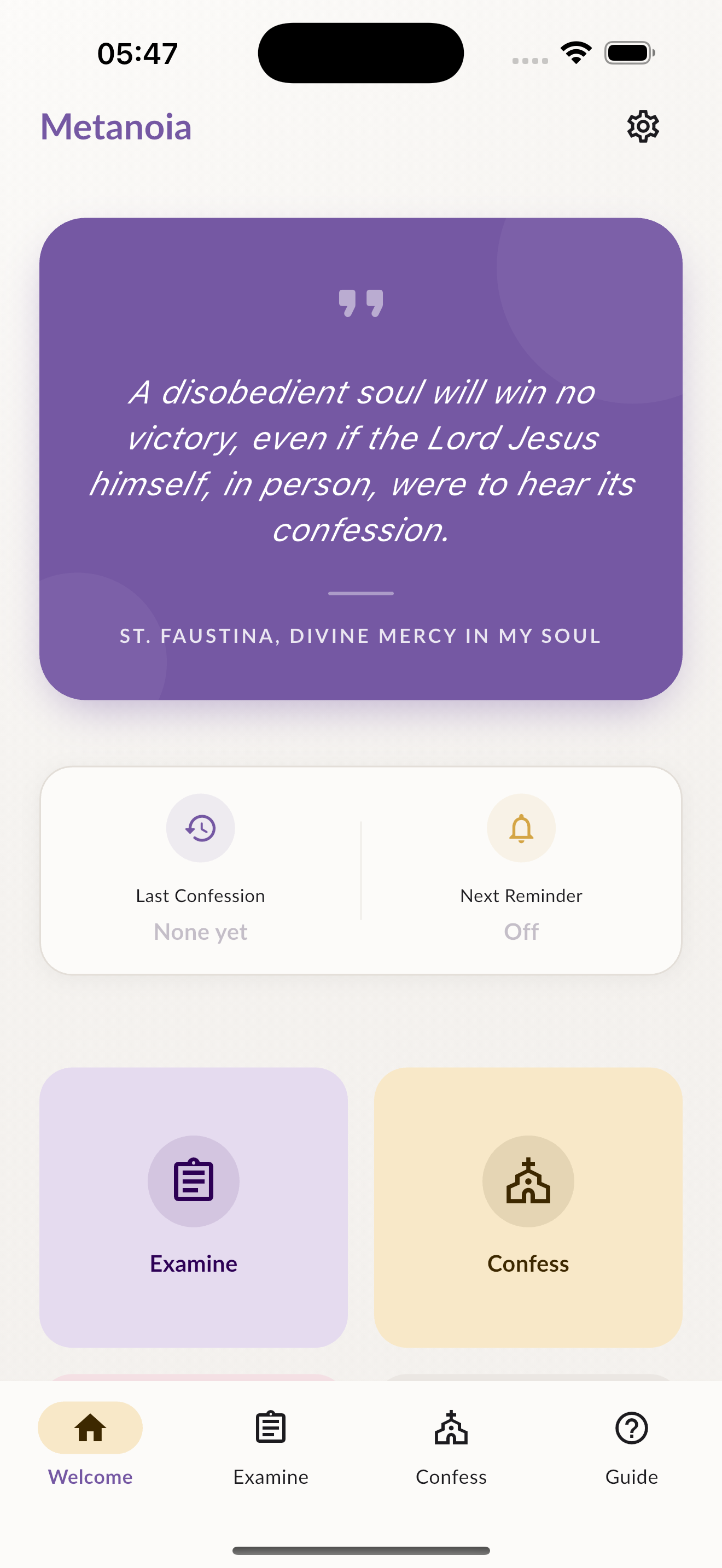
Home Dashboard

Home Dashboard

Begin each session with an inspiring word from Scripture or the Saints.
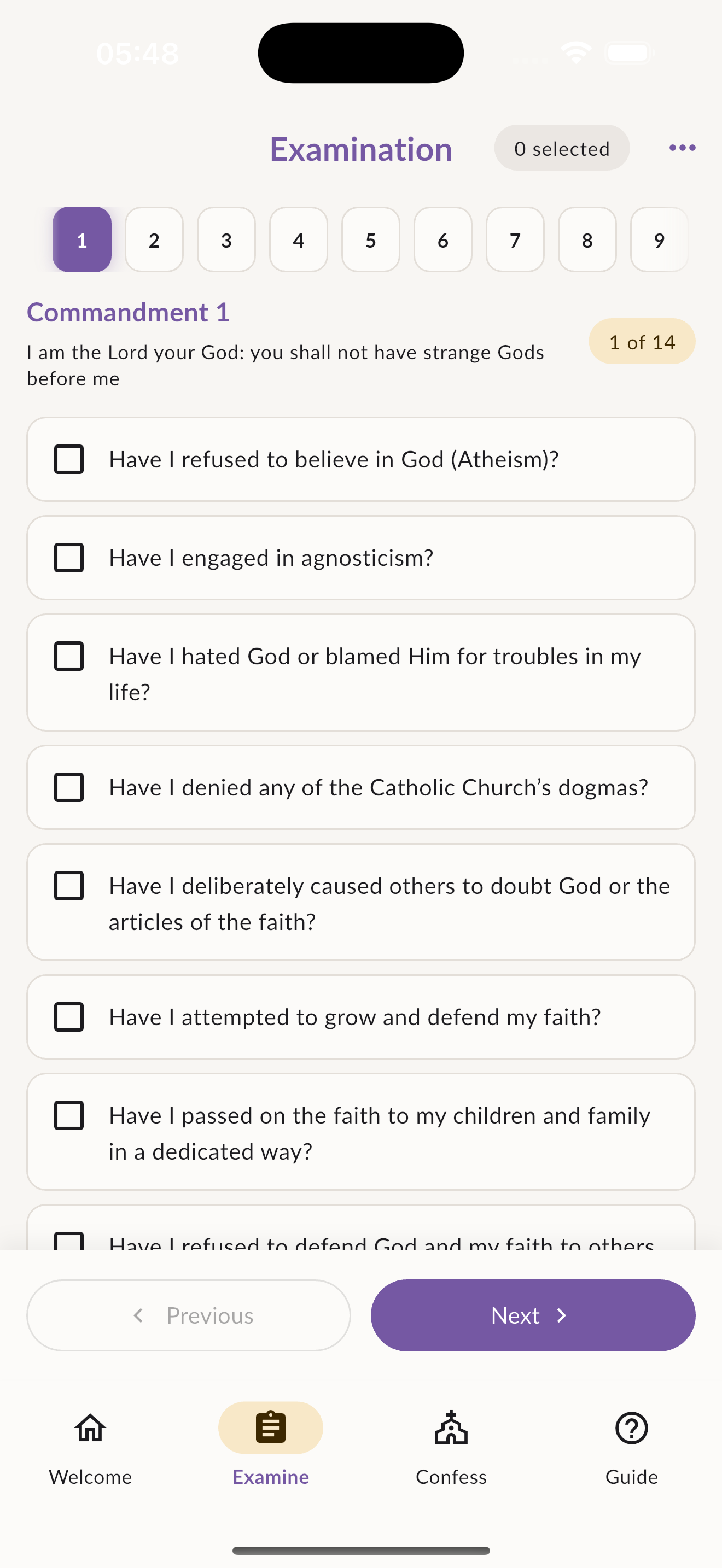
Examination

Examination

Work through the commandments at your own pace. Your progress is always saved.
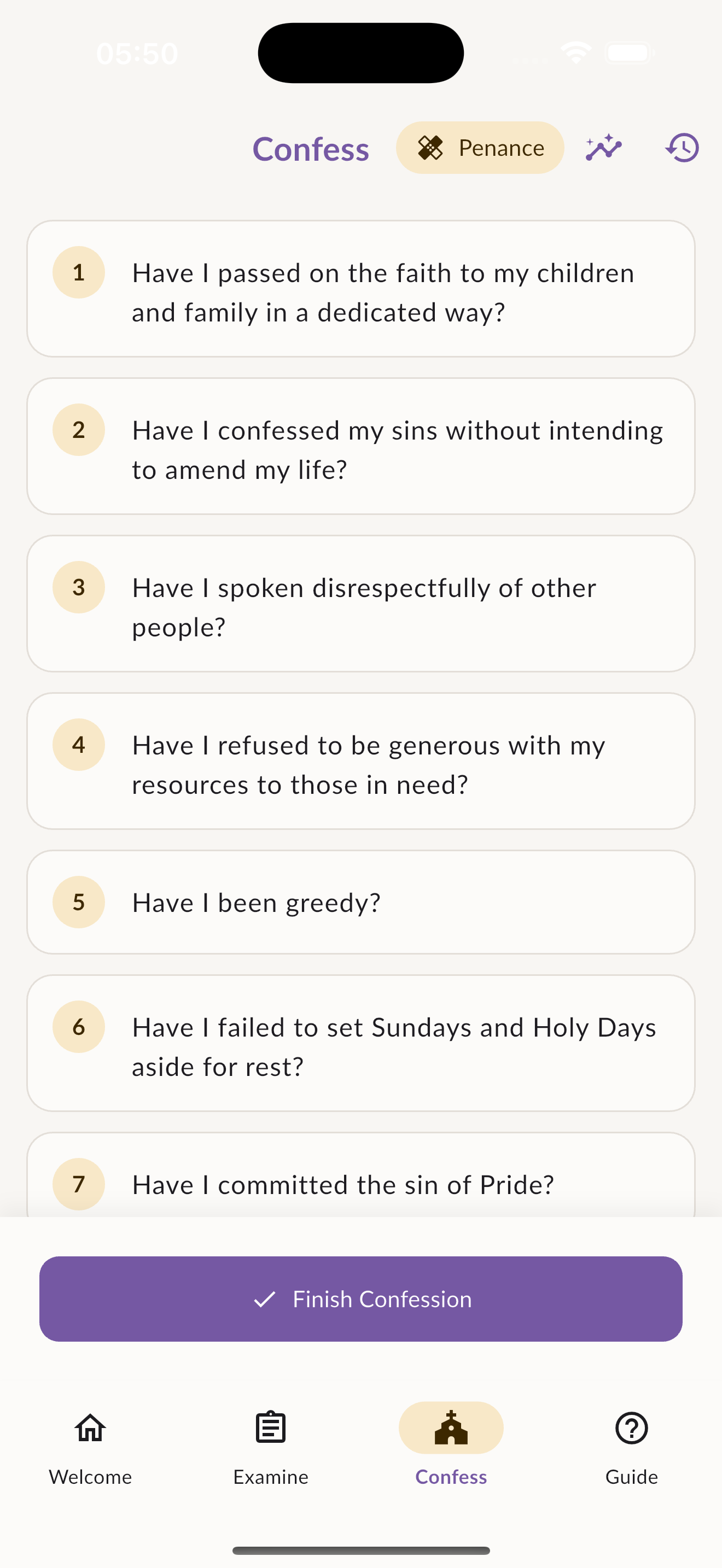
Confession Mode

Confession Mode

During the sacrament, follow along with prayers and your prepared list.
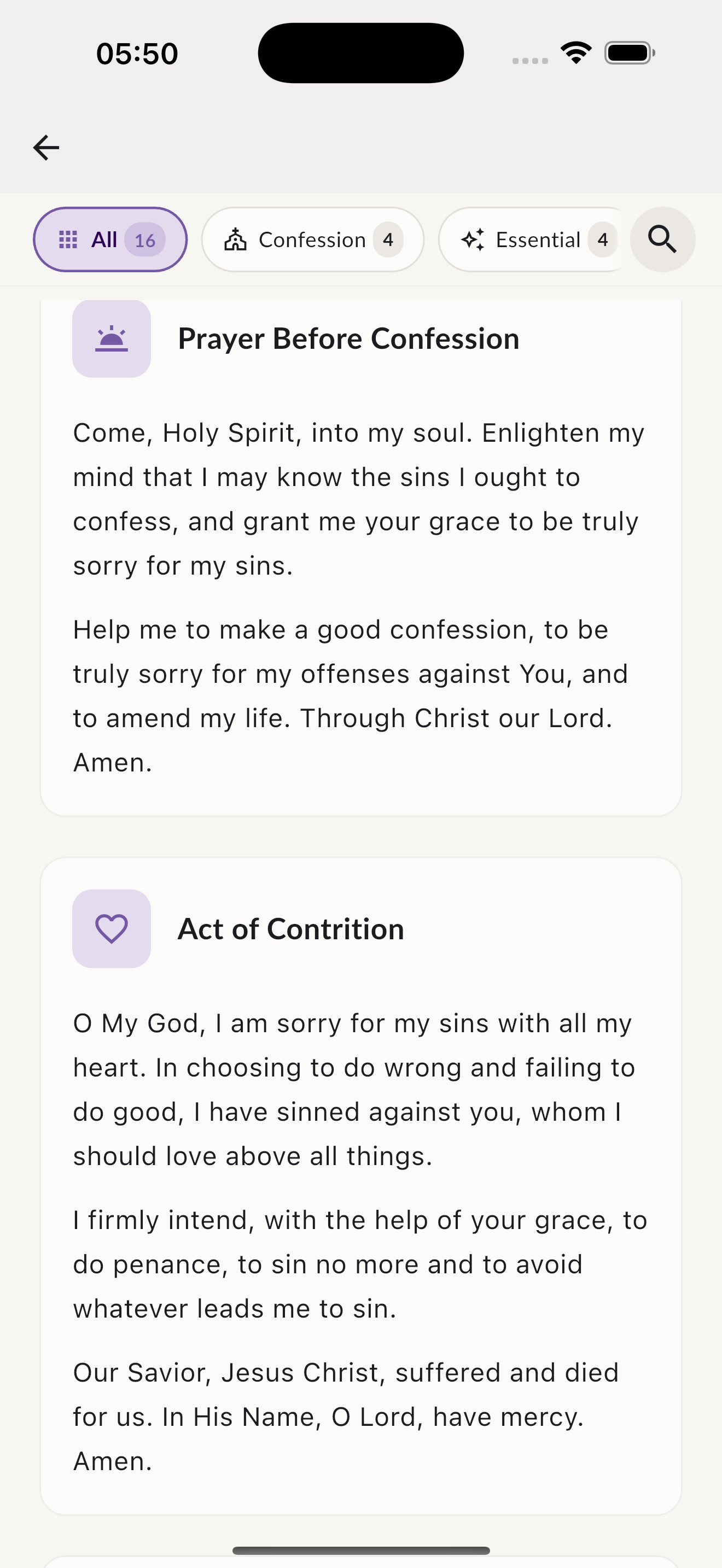
Prayers

Prayers

Access the Act of Contrition and other prayers whenever you need them.
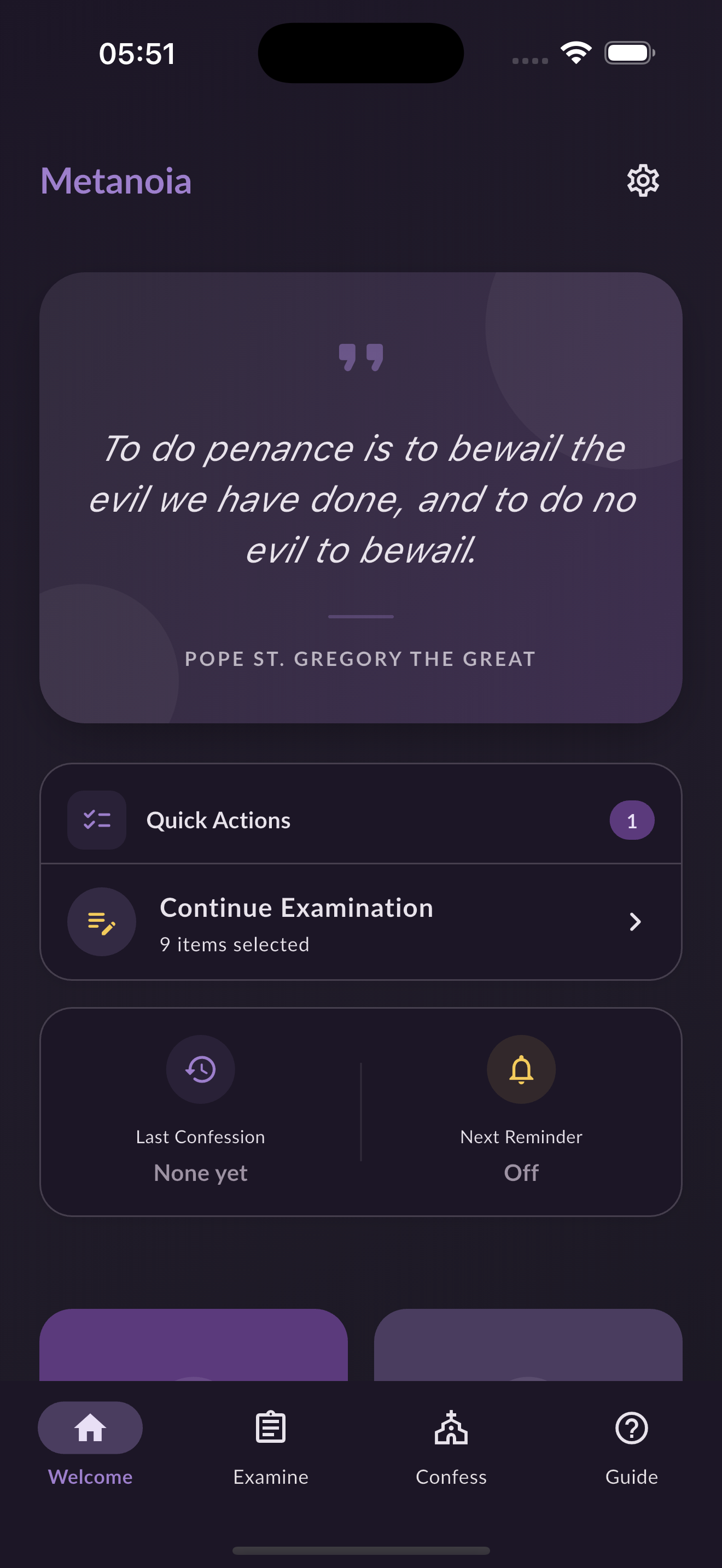
Dark Mode

Dark Mode

Full dark theme for comfortable use in the quiet of the confessional.

Thoughtful Animations Dark Mode English, Malayalam, Portuguese, French & Spanish

Rooted in Truth

All content in Metanoia is drawn from:

Sacred Scripture Catechism of the Catholic Church Approved Liturgical Texts Wisdom of the Saints
"

"If we confess our sins, he is faithful and just and will forgive us our sins and purify us from all unrighteousness."

— 1 John 1:9
"

"The Lord is compassionate and gracious, slow to anger, abounding in love. He does not treat us as our sins deserve or repay us according to our iniquities."

— Psalm 103:8-10
"

"I will give you a new heart and put a new spirit in you; I will remove from you your heart of stone and give you a heart of flesh."

— Ezekiel 36:26

Available in English, Malayalam, Brazilian Portuguese, French, and Spanish.

Privacy

Your data never leaves your device.

  • Confession and private areas protected by PIN or biometrics
  • All data encrypted and stored only on your device
  • No account required — completely offline

Read our Privacy Policy
Metanoia PIN lock screen - protected access
PIN / Face ID Protected

Common Questions

Everything you need to know about Metanoia.

Is Metanoia really free?

Yes, completely free. No ads, no in-app purchases, no hidden costs. It's our gift to the Church.

Do I need to create an account?

No. We don't want your email or personal information. Everything stays on your device.

Is my data truly private?

Absolutely. All data is encrypted and stored only on your device. Confession and private areas are protected by PIN or biometrics (Face ID/Touch ID). We have no servers — your spiritual life stays between you and God.

What languages are supported?

English, Malayalam, Brazilian Portuguese, French, and Spanish.

Can I use this during confession?

Yes! The Confession Mode is designed for discreet use during the sacrament itself.

Who made this app?

Metanoia is created by Holystack, a Catholic initiative dedicated to building free, faithful apps for the Church. The app is open source — you can view and contribute to the code on GitHub.

Is Metanoia open source?

Yes! Metanoia is fully open source under the MIT license. You can view the source code, report issues, and contribute at github.com/holystack-dev/metanoia. We believe transparency builds trust, especially for an app that handles something as sacred as your examination of conscience.

How can I help?

Pray for us! You can also contribute to the project on GitHub — whether through code, translations, bug reports, or feature suggestions. And if Metanoia has blessed you, share it with others who might benefit.
Metanoia

Turn Back to Grace

Download Metanoia free on iOS and Android.

Available in English, Malayalam, Brazilian Portuguese, French, and Spanish

"The sacrifice acceptable to God is a broken spirit; a broken and contrite heart, O God, you will not despise."

— Psalm 51:17

Go in Peace

We pray that Metanoia helps you encounter the boundless mercy of our Heavenly Father.

May this tool serve your journey toward holiness, and may you always know the joy of returning to grace.

Contribute on GitHub Open source. Built with love for the Church.
"Peace I leave with you; my peace I give you. I do not give to you as the world gives. Do not let your hearts be troubled and do not be afraid."
— John 14:27

God bless you.